
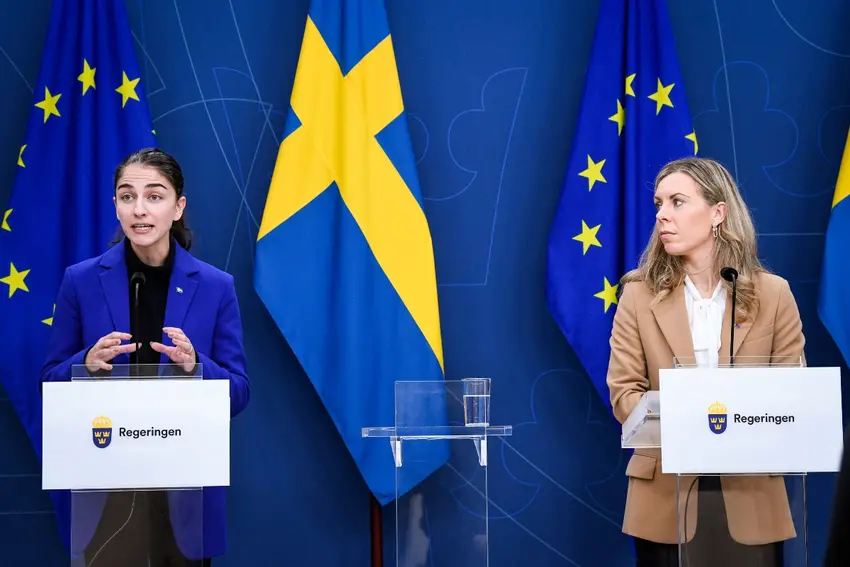
When the Tidö Agreement, which forms the basis of Sweden's three-party coalition government's policy, blew a giant hole in the country's climate policy back in 2022, Sweden's incoming climate minister Romina Pourmokhtari promised to fill it with a broader mix of alternative, more efficient measures.
Wait, she said, for the Climate Action Plan the government would publish at the end of 2023.
"There's a reason why the climate action plan has to be proposed one year after the election according to climate law," she told the Dagens Nyheter newspaper. "It's important that we don't put all our eggs in the same basket like we did with the biofuels obligation, but instead build a robust policy," she told Svenska Dagbladet.
She would resign, she added, if she couldn't develop a climate policy she felt able to defend.
The hole arose largely as a result of the three government parties' agreement with the Sweden Democrats to cut back on one of the most important elements of Sweden's plan, the biofuels obligation, or reduktionsplikten, at the same time as slashing taxes on petrol and diesel. The new government then went on to announce further policies that slowed the transition away from fossil fuels, scrapping the bonus given to buyers of electric cars, and forcing developers of off-shore wind farms pay for their own grid connections.
When its first budget revealed that these changes would lead to a sharp rise in emissions, putting Sweden's climate goals at risk, Pourmokhtari again and again asked people to wait for the climate policy action plan.
But when the plan finally arrived, slipped out three days before Christmas Eve, there were no new "eggs" in the basket at all.
The Swedish Climate Policy Council, which is responsible for appraising government climate plans, judged that the plan entirely "lacks measures to reach Sweden's climate goals and EU commitments by 2030". The government's claims that the plan pointed the way to reaching net zero in 2045 were, it said, "misleading" and "not based in fact".
Instead, the government promised to appoint an inquiry which would itself develop the new policy instruments to reduce emissions that Pourmokhtari had promised.
Last week, a full eleven months later, it finally did this - again slipping out the announcement late on a Friday, just as many people were leaving for the autumn holiday.
The government has made a point of speeding up the pace of government inquiries. But not this one. The new inquiry has been given a leisurely 18 months to do its work, delivering its conclusions in May 2026.
This is so close to the next election that there is no chance of anything being enacted in this mandate period. This means that apart from a modest upward adjustment in the biofuels obligation in the budget for 2025, Pourmokhtari will have done nothing of consequence to fill the hole in the emissions reductions plan her government's policies created.
Moreover, the instructions to the inquiry themselves betray the heavy influence of the far-right Sweden Democrats. They explicitly block Svante Mandell, the economist leading it, from proposing most of the most obvious ways of cutting diesel and petrol use.
He should not, the instructions read, propose using taxation or distance-based road pricing. He should ensure that any proposals do not bring "unreasonably high costs" and are "acceptable to the public". He should ensure that they do not have "damaging effects on parts of the country or society".
After the announcement, Pourmokhtari did a rare interview with Dagens Nyheter in which she seemed to have all but given up, saying that agreeing climate policy with the far-right Sweden Democrats had forced her into "doing the splits" to make everything work.
"It's an alliance where I need to bring forward arguments and perspectives which I myself do not always share," she admitted.
But is it a climate policy she feels able to defend? Either way, it doesn't look like she has any plans of resigning.
Comments